Instagram Growth Mistakes Creators Can Fix This Week
Replace common creator growth habits that waste effort with clearer goals, honest calls to action, and repeatable learning.

Most growth problems are not solved by adding more tactics. Often the account is asking the wrong question, measuring a number that does not match its goal, or changing too many things at once.
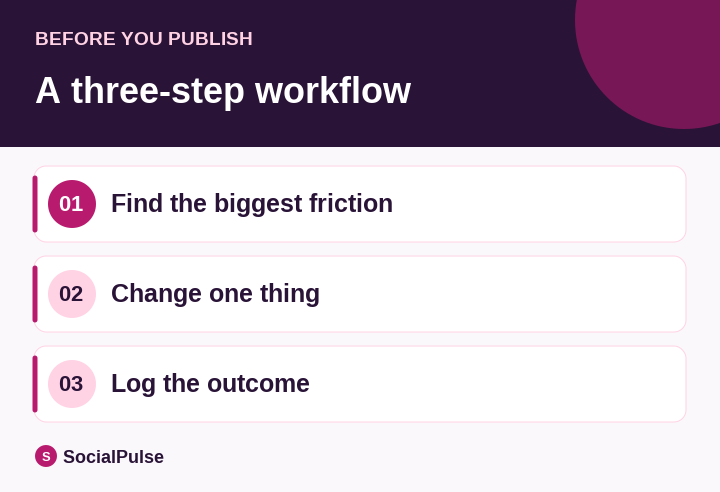
Find the first broken step
Take five recent posts and write the action you expected from each: save, share, visit the profile, or click the link. Compare it with the signal available to you. A post can do the job it was designed for even if it receives few likes.
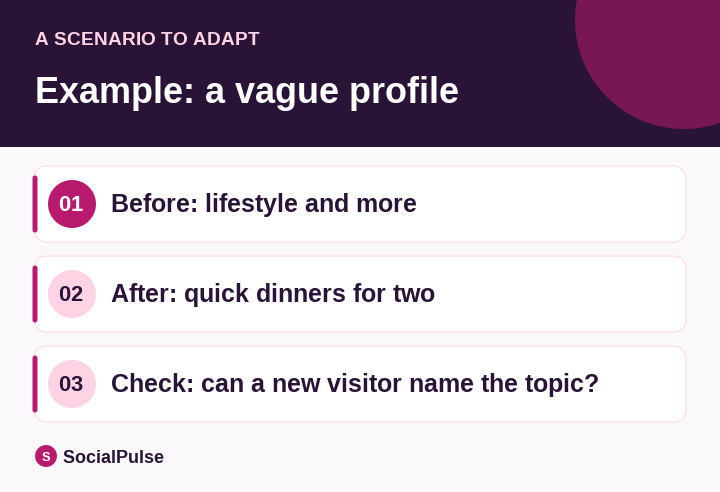
Worked example
Several tutorial posts drive profile visits, but strangers cannot tell what the account teaches from the bio. A clearer promise and one pinned beginner guide are a smaller experiment than remaking the whole feed.
What to do with the result
Fix one point of confusion. Track the same action on the next few comparable posts before making a second change.
Chasing every trend
A trend is a format, not a strategy. Before joining in, ask whether the idea makes sense for your audience and whether you can add a perspective of your own. If the only reason to post is that a sound is popular, the result may attract attention without helping people understand your work.
Using vague calls to action
“Thoughts?” is easy to write but hard to answer. Ask a more specific question connected to the post: which step felt hardest, what would they change, or what should the next example cover? A clear prompt improves the conversation and gives you more useful feedback.
Changing the whole strategy after one result
A post can perform unusually well or poorly for reasons you cannot see. Keep a record of the idea, opening, format, and goal, then look for repeated patterns across several posts. Make the next adjustment small enough that you can tell what you learned.
A working guide for your next session
Replace vague calls to action
“Comment below” does not tell a person what kind of response would help. Ask one specific, relevant question or offer a next step that fits the post. Do not pressure people to tag friends or share personal information. A useful invitation makes participation easier and gives you clearer feedback than a generic engagement request.
Stop changing several things after one weak post
A post can underperform for many reasons: topic, timing, opening, format, or simple variation. Before making a major change, compare it with similar work and note what was different. Choose one adjustment for the next attempt. This protects a promising format from being abandoned after one result and makes the next result more informative.
Make consistency about usefulness, not volume
A crowded calendar cannot compensate for an unclear account promise or rushed work. Review whether each post has a reason to exist and whether its production cost is manageable. If you need more consistency, build a smaller process you can repeat. Protect time for replies and learning as part of the work, not as leftover chores.