Build Instagram Content Pillars That Leave Room to Create
Organize your Instagram ideas into a few useful themes without making every post feel like the same template.
Content pillars are guardrails, not boxes. They help a creator recognize which ideas belong together, while leaving enough room for experiments, timely stories, and the subjects your audience brings up.
Give each pillar a different job
Tag your last twelve posts by audience problem and by the job of the post. Two formats can solve the same problem. Two posts with matching colors can solve different ones.
Worked example
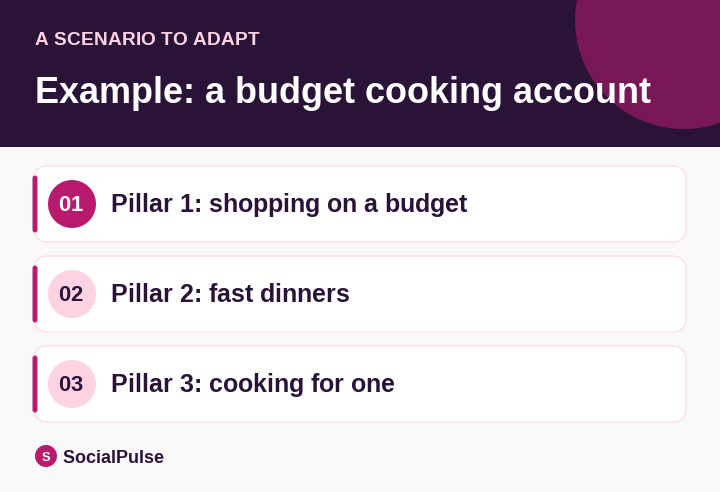
A renter’s cooking account separates “one-pan dinners,” “cheap shopping,” and “leftovers.” Its leftovers theme can become a 15-second demo, an ingredient chart, or a Story answer without losing the reason people follow.
What to do with the result
If you cannot describe the viewer’s problem for a pillar, replace it with a question that appears in replies. Keep any good format you already know how to produce.
Choose themes from audience needs
Start from recurring questions, misconceptions, and moments when your audience needs encouragement. A food creator might teach a technique, share a recipe test, and explain ingredient choices. These themes are distinct, but they all help the same viewer cook with more confidence.
Give each theme a different format
One pillar can support several formats. A short demonstration, a photo sequence, and a myth-versus-fact explanation can all serve the same topic. This keeps repetition from becoming visual sameness and helps you learn which presentation suits each idea.
Retire pillars that no longer help
Review your themes every few months. If one theme consistently feels forced or attracts an audience unrelated to your goal, adjust it. Keep a small “open ideas” list for posts that do not fit yet; a good observation should not be discarded just because it breaks the calendar.
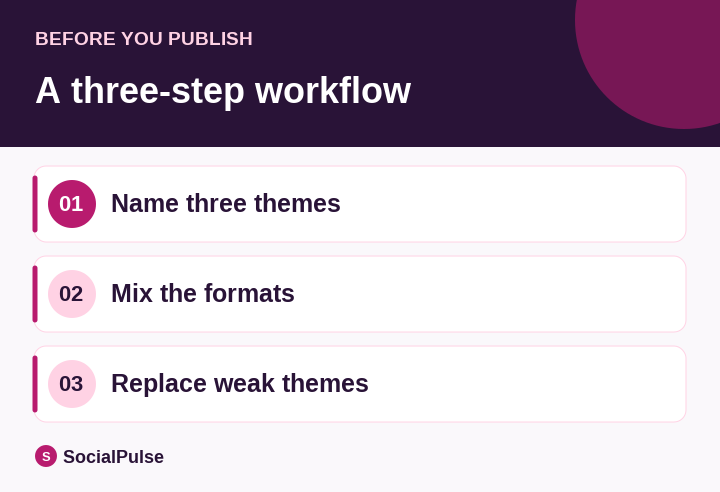
A working guide for your next session
Build pillars from recurring audience needs
Collect questions from comments, conversations, search behavior, and your own support work. Group them by the help people need, not by the format you want to promote. A cooking account could have technique, meal planning, and ingredient choices as themes. If a theme cannot produce several distinct, useful ideas, it may be too narrow or not important enough to anchor a pillar.
Let formats vary inside a theme
A single topic can work as a short demonstration, a carousel, a personal story, or a response to a common misconception. Choose the format based on what makes the point easiest to understand. The theme supplies continuity; the format supplies variety. This helps a series feel recognizable without forcing every post into the same visual template or script.
Review the pillars without treating them as rules
Keep a small space for timely ideas and observations that do not fit the current list. Every few months, ask which themes still reflect your audience and which have become repetitive. A pillar can be renamed, combined, or retired. The purpose is to make planning easier and the account clearer, not to reject good ideas because they missed a category.