Improve Short-Video Retention by Giving the Story a Shape
Keep short videos easy to follow by arranging them around a question, a meaningful change, and a clear ending.

Retention is not a trick to keep people trapped in a video. It is a sign that the sequence gave them a reason to continue. Strong short videos move through a clear idea without adding empty pauses or withholding an answer.
Edit for cause and effect
Put three lines above the timeline: the viewer’s question, the thing that changes, and the payoff. Watch every shot and assign it to one of those jobs. Trim a shot that repeats the previous beat unless the detail changes the answer.
Worked example
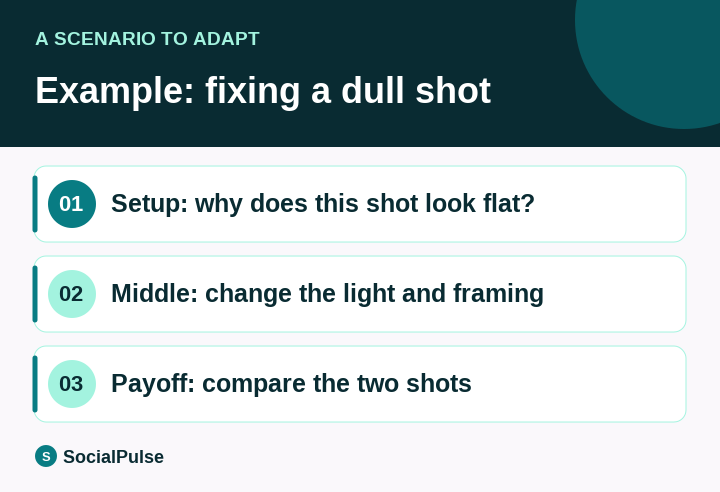
In a camera demo, the story is “why is this shot flat?” Show the flat shot, move the key light, and put the result beside the original. A second angle of the untouched light adds little.
What to do with the result
If viewers can predict the ending early, make the reveal arrive sooner. If the ending surprises them for the wrong reason, add the missing setup instead of speeding up the edit.
Give the viewer a question to follow
A tutorial can create anticipation by showing the problem before the fix. A personal story can name the decision at stake. The viewer should know what they are waiting to understand. If the video contains several ideas, consider splitting them into separate pieces rather than rushing all of them into one.
Use each cut to add information
Remove repeated phrases, long setup, and visual changes that do not advance the idea. A cut can reveal a closer view, a new step, or the result of an action. Captions help clarify speech, but they should not cover the important part of the frame.
Let the ending complete the promise
Show the result, summarize the decision, or offer one relevant next step. Avoid a generic “wait until the end” when the ending has no payoff. If viewers drop at a specific point, inspect whether the story slows down or moves away from the opening promise.
A working guide for your next session
Give the story a clear progression
A simple arc can be a problem, an attempt, and a result. Establish the situation quickly, show the detail that changes the outcome, and finish with what the viewer should understand. If the clip is educational rather than personal, the progression can be a question, a demonstration, and a takeaway. The viewer should be able to follow the logic without needing extra context.
Remove delays while keeping useful context
Cut repeated explanations and transitions that do not help the viewer follow the change. Keep moments that establish credibility, safety, or an important qualification. Captions and close-ups can make a step easier to see, but too many edits may compete with the point. Watch once at normal speed and ask whether each moment moves the idea forward.
Use retention as a clue to investigate
If people leave at a particular moment, inspect what the video asks of them there. Is the next step unclear, does the pace change, or did the opening promise something the body does not address? Do not assume the graph reveals a single cause. Make one targeted change in a future video and compare it with a similar piece to learn whether clarity improved.